book
The Extended Phenotype
First published 1982307 pages
Genes don't just build bodies — they shape the entire environment around them.
Why it’s worth your time
Richard Dawkins wrote this 1982 book for professional biologists and considers it his principal contribution to evolutionary theory. Its argument extends The Selfish Gene: a gene's effects don't stop at the body that carries it. Beavers' dams and caddis-fly cases are as much the products of genes as teeth or eyes, and so is the behavior of a host manipulated by a parasite — like the crickets driven to drown themselves by the hairworms inside them.
It's more technical and more argumentative than his popular books, and reviewers noted that the first nine chapters mostly defend the gene's-eye view against critics. The last five chapters, where the extended phenotype itself appears, are the original part and the reason to read it.
Where to start
- The chapter on animal artifacts
Dams, nests and caddis houses as the phenotypes of genes. The idea at its clearest.
- The chapters on parasites and action at a distance
Hosts manipulated by the genes of parasites, and cuckoo chicks that commandeer their foster parents.
- The final chapter
Why, if genes are what matter, life comes packaged in separate organisms at all.
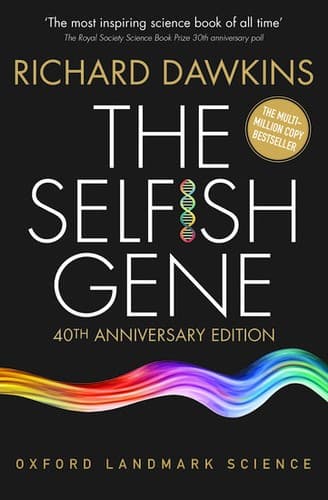
- The Selfish Gene
The popular book this one extends. Read it first.
About Richard Dawkins
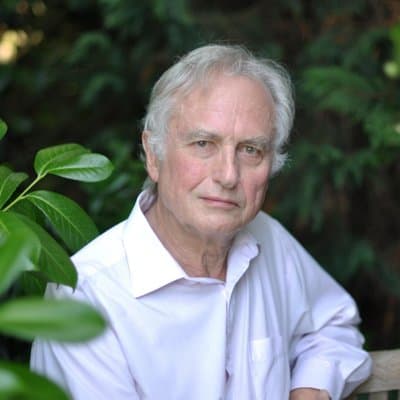
Richard Dawkins is a British evolutionary biologist and an emeritus fellow of New College, Oxford, who from 1995 to 2008 was the first Simonyi Professor for the Public Understanding of Science. His books include The Selfish Gene (1976), The Blind Watchmaker (1986) and The God Delusion (2006).
Everything by Richard Dawkins