WEEKLY DISPATCH
What the Data Gives Away
Monday, July 20, 2026
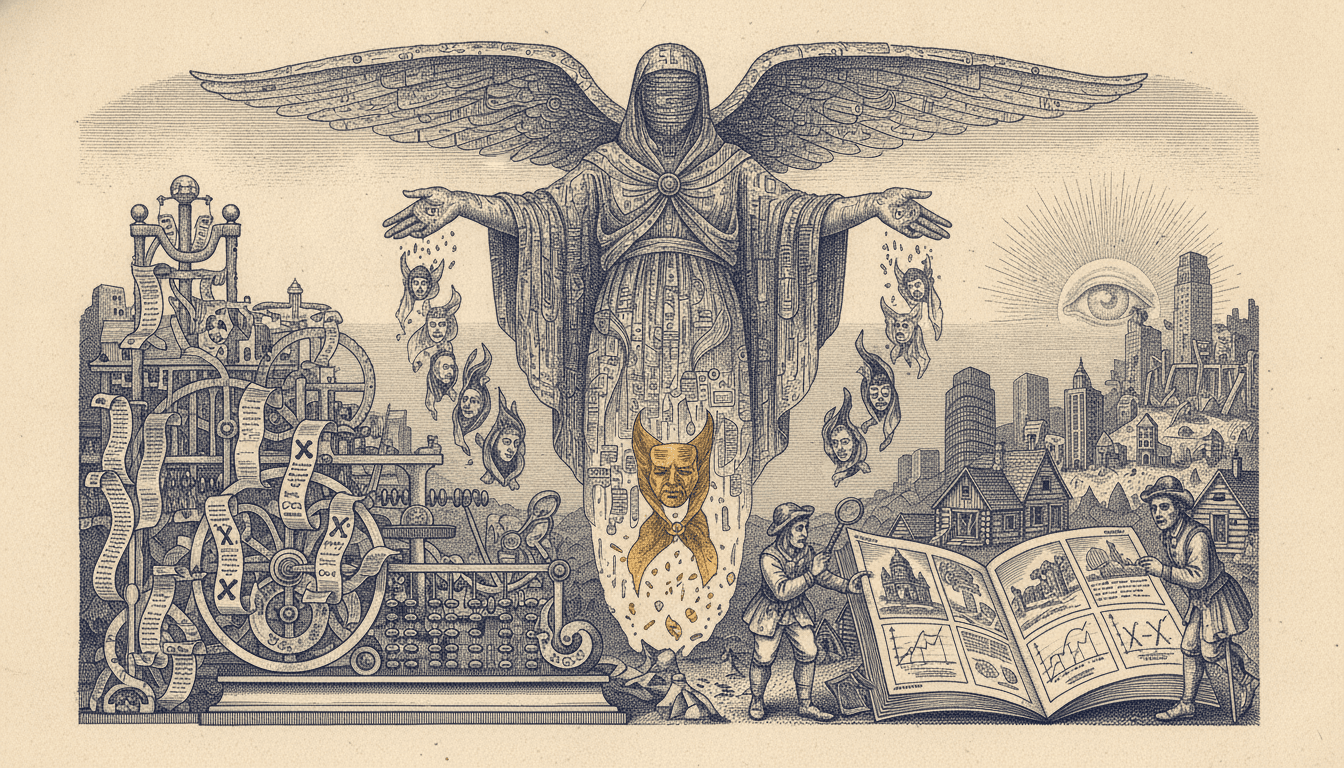
Everything you write, pass, or ship leaves a measurable trace — and this week's best pieces are all about what happens when someone finally measures it.
The end of anonymous
Dynomight's Pseudpocalypse argues internet pseudonymity is on borrowed time because writing style is a fingerprint. Uniquely identifying one English speaker among ~490 million requires only 29 bits of information, and a typical person leaks far more than that in a thousand words — roughly 17 bits from demographic tells, ~39 from personality markers, ~50 from punctuation habits and rare-word frequency. Today's published stylometry only separates about 50 authors reliably; the essay's bet is that LLM-scale models blow past that the way they blew past everything else. If you write under two names, this is the most personally actionable information theory you'll encounter.
Laws as technologies
Brian Potter's How Predictable Are Laws? does something genuinely novel: he scored 239 federal laws passed between 1976 and 2023 against their intended effects. About 40% landed roughly as promised; about 11% diverged wildly. The examples are the payoff — NEPA's environmental-impact clause, barely noticed at passage, became a mass-litigation weapon; the 401(k) provision projected to have "negligible effect" became the fifth-largest tax break; an $800 de minimis tariff exemption inadvertently built Chinese fast fashion. Potter's thesis is that laws behave like technologies: once deployed, people find uses the designers never imagined.
The catalog rewrite
Tyler Cowen flags MIT work that rebuilds American growth estimates from 5.1 million Sears catalog listings, 1900–1990. Using LLMs to extract product attributes and build a quality-adjusted price index, the authors find real goods consumption grew 39-fold — not the 10-fold standard deflators imply — with the gap largest before World War II. If it holds up, the conventional story that American consumer prosperity is mostly a postwar phenomenon is quietly wrong, and it took a language model reading old catalogs to notice.
The consciousness trap
Erik Hoel's Anthropic Runs Like Wile E. Coyote into the Brick Wall of Consciousness Research is the best-credentialed skeptical response to the year's splashiest AI-consciousness result. Anthropic found a "global workspace" structure in Claude; Hoel, a neuroscientist who worked on consciousness theory, argues the method is circular — it measures reportability, then presents reportability as evidence of the thing reportability was supposed to indicate, and the structure doesn't even replicate in open-source models. He grants it's a real finding about transformers. He just won't let anyone call it consciousness, and his explanation of why the framing is commercially convenient is the essay's sharpest turn.
The captive-audience reckoning
Ted Gioia reads Netflix's post-earnings collapse — two years of stock gains erased — as the end of audience capture: the playbook of milking locked-in users with higher prices and less product. Scripted output down from its 2022 peak, prices up, viewership numbers hidden until 2027, and the same pattern visible at Meta, whose users declined for the first time in Q1. What makes this better than the average tech-doom essay is that it's testable — Gioia gives himself 12–18 months to be proven right or wrong.
Also worth your time
Quanta had a strong week: Natalie Wolchover on why 10% of us are left-handed — handedness starts in the spinal cord, weeks before the brain is wired to the limbs — and Philip Ball on thermodynamic computers that exploit thermal noise instead of fighting it, a credible non-quantum path to radically cheaper AI compute. And EconTalk's Spin Master episode is a numbers-rich rebuke to startup orthodoxy from a man who turned a stocking full of sawdust into PAW Patrol.
The thread
Stylometry unmasks writers, catalog data unmasks a century of growth, outcome-scoring unmasks Congress, and earnings reports unmask the streaming playbook. Measurement is the theme — including Hoel's reminder that the instrument can also fool the person holding it.