book
The Spirit of the Laws
by Montesquieu
First published 1748447 pages
The Enlightenment treatise on separation of powers that shaped every modern constitution.
“Power must check power by the arrangement of things.”
Why it’s worth your time
Montesquieu, a French aristocrat and judge, spent many years on this vast comparative study of laws and governments, published anonymously in 1748. It argues that laws must fit a people's form of government, climate, terrain, religion, commerce and customs, and that each kind of government runs on a principle: virtue in republics, honor in monarchies, fear in despotisms. Its most influential pages, on the constitution of England, argue that liberty depends on separating legislative, executive and judicial power.
That idea shaped the US Constitution — Madison called him "the celebrated Montesquieu" in Federalist No. 47 — and constitutions around the world. The Catholic Church put the book on its index of prohibited books in 1751. It's enormous and uneven, and its theories about climate now read as crude; read the parts on governments and liberty.
Where to start
- Books II and III: the three kinds of government and their principles
Republics, monarchies and despotisms, and what makes each work.
- Book XI: political liberty and the constitution
The separation of powers and the famous chapter on England.
- Book XIX: laws and the general spirit of a nation
How customs and manners shape what laws can do.
- The free Online Library of Liberty edition
The classic eighteenth-century English translation, free.
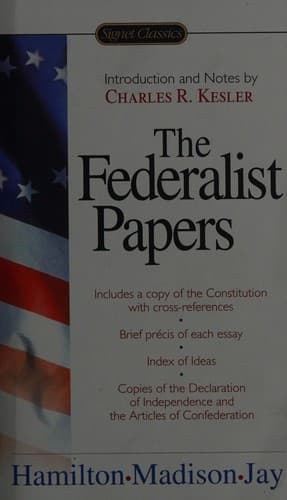
- The Federalist Papers
Where Montesquieu's separation of powers was put to work.
About Montesquieu
Montesquieu (1689–1755) was a French jurist, historian and political philosopher, the principal source of the theory of the separation of powers. His The Spirit of the Laws (1748) influenced the framers of the US Constitution.
Everything by Montesquieu