WEEKLY DISPATCH
The Arsenal of Democracy
Monday, February 16, 2026
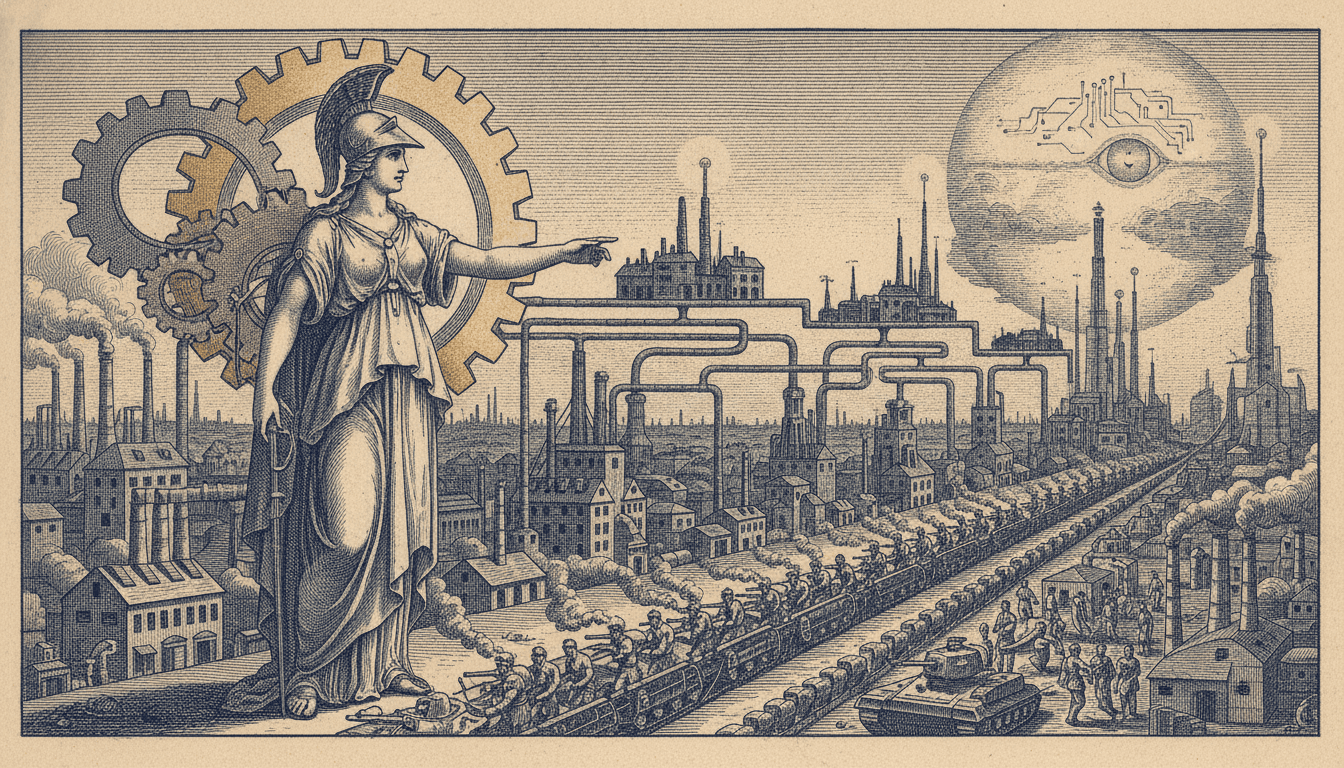
How do you build 100,000 aircraft a year when you built 3,100 the year before? One podcast episode this week answered that question with startling specificity.
The production miracle
Brian Potter joined EconTalk to discuss how America built the Arsenal of Democracy — the industrial mobilization that transformed the US from a peacetime economy into the world's largest weapons manufacturer in under three years. The details are staggering: aircraft production went from 3,100 planes in 1937 to nearly 100,000 annually by 1944. Potter traces the logistics — massive factory buildouts, constant design changes mid-production, quality control at industrial scale, and the critical role of 500,000 women workers. The episode works because it treats the mobilization as a logistics problem rather than a patriotic narrative, and the lessons for modern supply chains are implicit but clear.
The scaling hypothesis, updated
Gwern's scaling hypothesis essay — originally written after GPT-3 — has become one of the most cited pieces in AI discourse. The argument that intelligence emerges from sufficiently large neural networks, and that "the blessings of scale" produce qualitatively new capabilities, was controversial in 2020. Five years later, the evidence has largely supported it. Whether you agree with the strongest version of the claim or not, the essay's framework — distinguishing between "scaling works" and "scaling is sufficient" — remains the clearest way to think about where AI capability comes from.
The scenario
Scott Alexander published Introducing AI 2027 — a scenario project led by Daniel Kokotajlo and a team of researchers that forecasts AI capabilities through 2027-2028. The scenario includes the possibility of an intelligence explosion driven by coding agents that accelerate AI research itself. Alexander's personal takeaways are characteristically measured: he highlights that cyberwarfare risks arrive before bioweapon risks, that a software-only singularity could accelerate faster than hardware constraints suggest, and that the geopolitics of superintelligence as a strategic weapon are underexplored. Whether the scenario is right matters less than whether it's useful for thinking clearly about what's coming.
The link
Arsenal of Democracy and AI 2027 are, at bottom, the same story: what happens when a system scales faster than anyone anticipated? In 1942, the answer was industrial transformation. In 2027, the answer might be cognitive transformation. The question is whether this generation will mobilize as effectively as the last one.