book
Rationality: What It Is, Why It Seems Scarce, Why It Matters
First published 2021432 pages
A guide to logical and statistical reasoning and why human rationality falls short.
Why it’s worth your time
Steven Pinker's 2021 book is a primer on the tools of good reasoning — logic, probability, Bayesian updating, expected utility, signal detection, game theory, correlation and causation — wrapped in an argument about why people who can reason perfectly well in daily life fall for conspiracy theories, fake news and paranormal claims. His answer is that much of what looks irrational is motivated reasoning in the service of belonging and status.
It reads like the best version of a university course: clear, funny and full of puzzles that catch even clever readers out. The chapters on statistics are the most useful. The later chapters on politics and "what's wrong with people" are more opinionated and will be more congenial to some readers than others.
Where to start
- Chapter 1: How Rational an Animal?
Hunter-gatherer reasoning and classic puzzles most people get wrong.
- Chapter 5: Beliefs and Evidence (Bayesian Reasoning)
The clearest popular explanation of Bayes's rule you'll find.
- Chapter 9: Correlation and Causation
How to tell what causes what — the skill most often missing from public debate.
- Chapter 10: What's Wrong with People?
Pinker's account of why sensible people believe nonsense.
About Steven Pinker
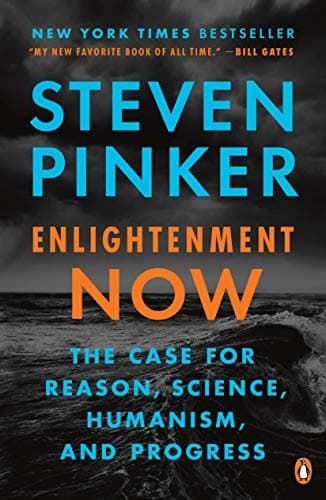
Steven Pinker is a Canadian cognitive psychologist and the Johnstone Family Professor of Psychology at Harvard. His books for general readers include The Language Instinct (1994), How the Mind Works (1997), The Blank Slate (2002), The Better Angels of Our Nature (2011) and Enlightenment Now (2018).
Everything by Steven Pinker