book
The Order of Things
First published 1966449 pages
An archaeology of the human sciences revealing hidden structures of knowledge.
Why it’s worth your time
Michel Foucault's 1966 book, the one that made him famous, is an "archaeology" of the human sciences. It argues that each era has an episteme — an unspoken set of rules that decides what can count as knowledge — and that these break suddenly rather than evolving. Tracing the study of language, living things and wealth, it shows how Renaissance resemblance gave way to Classical order and representation, and then to the modern sciences of linguistics, biology and economics, with "man" at their center.
It opens with a dazzling reading of Velázquez's painting Las Meninas and then becomes very hard going, dense with eighteenth-century grammarians and naturalists. It's Foucault at his most abstract; his later books on prisons and sexuality are more accessible and more influential. Read it if the idea of hidden rules for knowledge grips you, ideally with a guide.
Where to start
- The opening analysis of Las Meninas
Who is looking at whom in Velázquez's painting, and what that says about representation. The book's most famous pages.
- The chapters on Classical representation
How seventeenth- and eighteenth-century knowledge was organized as tables and orders. The core of the archaeology.
- The closing chapters on "man" and the human sciences
Foucault's argument that our idea of the human subject is recent, and may not last.
- The Stanford Encyclopedia of Philosophy on Foucault
A clear guide to the book's argument and where it fits in Foucault's work.
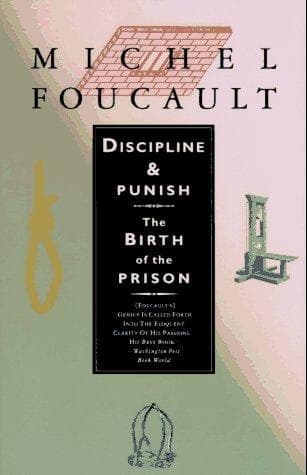
- Discipline and Punish
Foucault's more accessible and more influential later book.
About Michel Foucault
Michel Foucault (1926–1984) was a French historian and philosopher associated with structuralism and post-structuralism. He held a chair in the history of systems of thought at the Collège de France from 1969, and his books on madness, medicine, knowledge, prisons and sexuality reshaped the humanities. He died of AIDS in 1984.
Everything by Michel Foucault